Thursday, March 16, 2006

Water and Indigenous Peoples


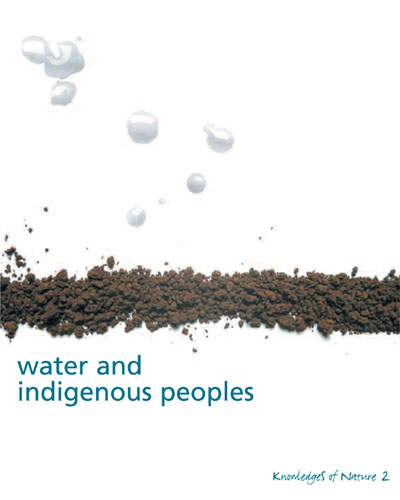
Edited by R. Boelens, M. Chiba and D. Nakashima. Knowledges of Nature 2, UNESCO: Paris, 177 pp., March 2006.

To request a copy, email - sc_links@unesco.org

This book has been launched by UNESCO during the Fourth World Water Forum in Mexico City (March 2006). It is based on the papers delivered atf the Second and Third World Water Forums (The Hague in 2000 and Kyoto in 2003). It brings to the fore some of the most incisive critics from indigenous communities of international debates on water access, use and management, as well as indigenous expressions of generosity that share community knowledge and insight in order to propose remedies for the global water crisis.

Water and Indigenous Peoples
advocates a revision of international development efforts to fully embrace indigenous peoples' knowledge, values, land tenure, customary management, social arrangements and rights pertaining to water. Contributions cover a wide array of approaches and issues, ranging from 'worldviews' to 'rights-based struggles'.

Water and Indigenous Peoples


Edited by R. Boelens, M. Chiba and D. Nakashima. Knowledges of Nature 2, UNESCO: Paris, 177 pp., March 2006.

To request a copy, email - sc_links@unesco.org

This book has been launched by UNESCO during the Fourth World Water Forum in Mexico City (March 2006). It is based on the papers delivered atf the Second and Third World Water Forums (The Hague in 2000 and Kyoto in 2003). It brings to the fore some of the most incisive critics from indigenous communities of international debates on water access, use and management, as well as indigenous expressions of generosity that share community knowledge and insight in order to propose remedies for the global water crisis.

Water and Indigenous Peoples
advocates a revision of international development efforts to fully embrace indigenous peoples' knowledge, values, land tenure, customary management, social arrangements and rights pertaining to water. Contributions cover a wide array of approaches and issues, ranging from 'worldviews' to 'rights-based struggles'.

Monday, March 13, 2006

"Education Makes News" training kit

UNESCO has launched a revised and improved the Education For All media training and resource kit titled “Education Makes News”. Education for All (EFA) is the international initiative to achieve education for all by 2015. The kit is to be used to encourage the communication media to highlight EFA goals locally, regionally and globally. The kit can be used to develop the interest, knowledge and skills of journalists and other media professionals in writing, reporting and investigating the EFA issues. It can help them to create stories from statistics and bring the EFA debate to the center stage. The revised kit has been updated with recent statistics, facts, and examples and newly organized contents. The technology used in the Computer Based Training (CBT) is simplified for easy use by learners/trainers.

Click here to downloaded the kit.

"Education Makes News" training kit

UNESCO has launched a revised and improved the Education For All media training and resource kit titled “Education Makes News”. Education for All (EFA) is the international initiative to achieve education for all by 2015. The kit is to be used to encourage the communication media to highlight EFA goals locally, regionally and globally. The kit can be used to develop the interest, knowledge and skills of journalists and other media professionals in writing, reporting and investigating the EFA issues. It can help them to create stories from statistics and bring the EFA debate to the center stage. The revised kit has been updated with recent statistics, facts, and examples and newly organized contents. The technology used in the Computer Based Training (CBT) is simplified for easy use by learners/trainers.

Click here to downloaded the kit.

Sunday, March 12, 2006

Philip Hall Coombs; Education Expert and Advocate

Read the obituary in the Washington Post, March 10, 2006.

Read the obituary in the New York Times, March 7, 2006.

Philip Hall Coombs, 90, the first assistant secretary of state for educational and cultural affairs, died Februar 15, 2006 in Chester, Conn.

Mr. Coombs worked for UNESCO's International Institute for Educational Planning in Paris. In 1970, he became vice chairman and then chairman of the International Council of Economic Development, focusing on improving education in developing countries.

His books include "The Fourth Dimension of Foreign Policy" (1964); "Education and Foreign Aid" (1965); "Attacking Rural Poverty: How Nonformal Education Can Help" (1974); and "The World Crisis in Education: The View From the Eighties" (1985).

"We praise education's virtues and count on it to help the new generation solve great problems which the older generation has failed to solve," Secretary Coombs told an international meeting in Washington in 1961. "But when it comes to spending more money for education, our deeds often fail to match our words."

Philip Hall Coombs; Education Expert and Advocate

Read the obituary in the Washington Post, March 10, 2006.

Read the obituary in the New York Times, March 7, 2006.

Philip Hall Coombs, 90, the first assistant secretary of state for educational and cultural affairs, died Februar 15, 2006 in Chester, Conn.

Mr. Coombs worked for UNESCO's International Institute for Educational Planning in Paris. In 1970, he became vice chairman and then chairman of the International Council of Economic Development, focusing on improving education in developing countries.

His books include "The Fourth Dimension of Foreign Policy" (1964); "Education and Foreign Aid" (1965); "Attacking Rural Poverty: How Nonformal Education Can Help" (1974); and "The World Crisis in Education: The View From the Eighties" (1985).

"We praise education's virtues and count on it to help the new generation solve great problems which the older generation has failed to solve," Secretary Coombs told an international meeting in Washington in 1961. "But when it comes to spending more money for education, our deeds often fail to match our words."

Saturday, March 11, 2006

22 March - World Day for Water 2006: Water and Culture

Go to UNESCO's website for the World Day for Water 2006.

The United Nations General Assembly has declared that 22 March of each year is World Day for Water. States are invited to devote the Day, as appropriate in the national context, to concrete activities such as the promotion of public awareness through the publication and diffusion of documentaries and the organization of conferences, round tables, seminars and expositions related to the conservation and development of water resources and the implementation of the recommendations of Agenda 21.

World Water Day (WWD) 2006 will be guided by the theme 'Water and Culture' under the leadership of UNESCO.