Tuesday, April 25, 2006

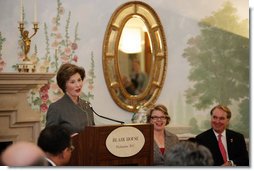
Mrs. Bush's Remarks at the UNESCO Education for All Week Luncheon


Read the transcript of the First Lady's remarks.

"Literacy is the foundation of personal freedom. Being able to read, and choosing what we read, is how we shape our beliefs, our minds, and our characters. Reading brings self-reliance and independence. For many women and their children, literacy can even mean the difference between life and death. A mother who can read can understand the label on a food container. She knows how to follow the instructions on a bottle of medicine. She's more likely to make wise decisions about her life that will keep her and her children healthy.

"Literacy is the foundation of economic freedom. Free markets require informed consumers, and that means consumers who can read. Wider literacy also increases economic participation, which leads to more stable and vibrant economies......

"Today, I'm delighted to announce that this September, during the opening of the 61st session of the U.N. General Assembly, we'll convene a Conference on Global Literacy in New York. Working in cooperation with the U.S. Department of Education, the U.S. State Department, the U.S. Agency for International Development, and UNESCO, the United Nations Scientific and Cultural Organization, we'll be looking at literacy programs that work, and connecting countries with the information they need to implement similar programs. The Conference will also encourage leaders from around the world to become involved in literacy in their own countries, and then to learn ways to support UNESCO's goal of Education for All by 2015."
Mrs. Bush's Remarks at the UNESCO Education for All Week Luncheon


Read the transcript of the First Lady's remarks.

"Literacy is the foundation of personal freedom. Being able to read, and choosing what we read, is how we shape our beliefs, our minds, and our characters. Reading brings self-reliance and independence. For many women and their children, literacy can even mean the difference between life and death. A mother who can read can understand the label on a food container. She knows how to follow the instructions on a bottle of medicine. She's more likely to make wise decisions about her life that will keep her and her children healthy.

"Literacy is the foundation of economic freedom. Free markets require informed consumers, and that means consumers who can read. Wider literacy also increases economic participation, which leads to more stable and vibrant economies......

"Today, I'm delighted to announce that this September, during the opening of the 61st session of the U.N. General Assembly, we'll convene a Conference on Global Literacy in New York. Working in cooperation with the U.S. Department of Education, the U.S. State Department, the U.S. Agency for International Development, and UNESCO, the United Nations Scientific and Cultural Organization, we'll be looking at literacy programs that work, and connecting countries with the information they need to implement similar programs. The Conference will also encourage leaders from around the world to become involved in literacy in their own countries, and then to learn ways to support UNESCO's goal of Education for All by 2015."

Wednesday, April 19, 2006

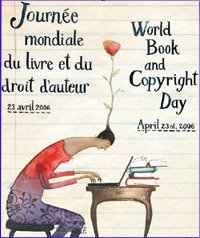
World Book and Copyright Day - April 23, 2006


Go to the UNESCO website for the World Book and Copyright Day, 2006.

By celebrating this Day throughout the world, UNESCO seeks to promote reading, publishing and the protection of intellectual property through copyright.

23 April: a symbolic date for world literature for on this date and in the same year of 1616, Cervantes, Shakespeare and Inca Garcilaso de la Vega all died. It is also the date of birth or death of other prominent authors, and was a natural choice for UNESCO's General Conference to pay a world-wide tribute to books and authors. UNESCO encourages "everyone, and in particular young people, to discover the pleasure of reading and gain a renewed respect for the irreplaceable contributions of those who have furthered the social and cultural progress of humanity".

World Book and Copyright Day - April 23, 2006


Go to the UNESCO website for the World Book and Copyright Day, 2006.

By celebrating this Day throughout the world, UNESCO seeks to promote reading, publishing and the protection of intellectual property through copyright.

23 April: a symbolic date for world literature for on this date and in the same year of 1616, Cervantes, Shakespeare and Inca Garcilaso de la Vega all died. It is also the date of birth or death of other prominent authors, and was a natural choice for UNESCO's General Conference to pay a world-wide tribute to books and authors. UNESCO encourages "everyone, and in particular young people, to discover the pleasure of reading and gain a renewed respect for the irreplaceable contributions of those who have furthered the social and cultural progress of humanity".

Tuesday, April 18, 2006

United Kingdom to give $15 billion to promote Education for All (EFA)

Read the full press release from UNESCO.

"The United Kingdom has pledged $15 billion in overseas aid for education in Africa and Asia over the next ten years."

United Kingdom to give $15 billion to promote Education for All (EFA)

Read the full press release from UNESCO.

"The United Kingdom has pledged $15 billion in overseas aid for education in Africa and Asia over the next ten years."

Saturday, April 15, 2006

Masterpieces of Intangible Heritage

UNESCO's Culture program includes a strong focus on the intangible heritage of mankind. Indeed, UNESCO is the managing U.N. agency for The Convention for the Safeguarding of the Intangible Cultural Heritage.

It has produced this webpage with an interactive map showing the entire List of Masterpieces of the Oral and Intangible Heritage of Humanity. Various lists down the left side of the webpage, plus a world map, allow visitors to the page to browse among the 47 proclaimed masterpieces and to consult detailed information, diaporamas, and videos on each of them.