Thursday, May 25, 2006

UNESCO's Associated Schools Project Network (ASPnet)

Founded in 1953, UNESCO’s Associated Schools Project Network (ASPnet), commonly referred to as UNESCO Associated Schools, is a global network of some 7,900 educational institutions in 176 countries (ranging from pre-schools and primary to secondary schools and teacher training institutions), who work in support of quality education in practice.

Following fifty years of networking with a view to reinforcing the humanistic, ethical, cultural and international dimensions of education, ASPnet commissioned a Global Review evaluation in 2003. More recently, it has evaluated the ASPnet News Infos, the ASPnet newsletter.

The ASPnet National Coordinator for the United States of America is:
Ms. Amy Ostermeier
U.S. National Commission for UNESCO
Department of State
2121 Virginia Ave.
Suite 6200
Washington DC 20037
Tel: (1.202) 663 0026
Fax: (1.202) 663 0035
E-mail: DCUNESCO@state.gov

UNESCO's Associated Schools Project Network (ASPnet)

Founded in 1953, UNESCO’s Associated Schools Project Network (ASPnet), commonly referred to as UNESCO Associated Schools, is a global network of some 7,900 educational institutions in 176 countries (ranging from pre-schools and primary to secondary schools and teacher training institutions), who work in support of quality education in practice.

Following fifty years of networking with a view to reinforcing the humanistic, ethical, cultural and international dimensions of education, ASPnet commissioned a Global Review evaluation in 2003. More recently, it has evaluated the ASPnet News Infos, the ASPnet newsletter.

The ASPnet National Coordinator for the United States of America is:
Ms. Amy Ostermeier
U.S. National Commission for UNESCO
Department of State
2121 Virginia Ave.
Suite 6200
Washington DC 20037
Tel: (1.202) 663 0026
Fax: (1.202) 663 0035
E-mail: DCUNESCO@state.gov

'10 STORIES THE WORLD SHOULD HEAR MORE ABOUT'

The 2006 list covers a spectrum of issues and geographical regions, some of which draw on troubling humanitarian emergencies and conflict situations (such as the Democratic Republic of Congo and Nepal) while others focus on such vital areas as human rights (asylum law and child prisoners) and development (Liberia and water as a shared resource). In this year's list, some stories focus on conflicts that may have been in the media spotlight - but highlight a perspective that does not usually get much play.

The United Nations each year publishes "Ten Stories the World Should Hear More About." The initiative was first launched in 2004. The short list of stories is not meant to be representative of the UN agenda. The ranking of the stories is not a reflection of their relative significance.

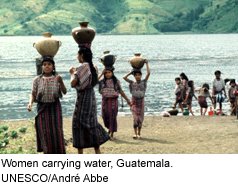
One of this years stories describes a UNESCO project, From Potential Conflict to Co-operation Potential (PCCP), that aims to foster cooperation between stakeholders in the management of shared water resources, while helping to ensure that potential conflicts do not turn into real ones.
From water wars to bridges of cooperation: Exploring the peace-building potential of a shared resource

'10 STORIES THE WORLD SHOULD HEAR MORE ABOUT'

The 2006 list covers a spectrum of issues and geographical regions, some of which draw on troubling humanitarian emergencies and conflict situations (such as the Democratic Republic of Congo and Nepal) while others focus on such vital areas as human rights (asylum law and child prisoners) and development (Liberia and water as a shared resource). In this year's list, some stories focus on conflicts that may have been in the media spotlight - but highlight a perspective that does not usually get much play.

The United Nations each year publishes "Ten Stories the World Should Hear More About." The initiative was first launched in 2004. The short list of stories is not meant to be representative of the UN agenda. The ranking of the stories is not a reflection of their relative significance.

One of this years stories describes a UNESCO project, From Potential Conflict to Co-operation Potential (PCCP), that aims to foster cooperation between stakeholders in the management of shared water resources, while helping to ensure that potential conflicts do not turn into real ones.
From water wars to bridges of cooperation: Exploring the peace-building potential of a shared resource

“Guidelines for Terminology Policies. Formulating and implementing terminology policy in language communities”

UNESCO just published this report that was prepared by the International Information Center for Terminology (Infoterm). Terminology planning occurs at different levels: national, regional, language community, local community, institutional or organizational. There are also terminology planning activities in various professional fields such as chemistry, biology, physics and medicine. In addition, there is a terminology component to virtually all standardization and harmonization activities, whether in industry or elsewhere. A terminology policy or strategy, especially when conceived and implemented at the national level, needs to take into account highly complex demographic, cultural, ethno-linguistic and geo-linguistic and socio-psychological factors. Infoterm, was founded in 1971 by UNESCO with the objective to support and co-ordinate international co-operation in the field of terminology. Members are national, international and regional terminology institutions, organizations and networks, as well as specialized public or semi-public or other kind of non-profit institutions engaged in terminological activities.

“Guidelines for Terminology Policies. Formulating and implementing terminology policy in language communities”

UNESCO just published this report that was prepared by the International Information Center for Terminology (Infoterm). Terminology planning occurs at different levels: national, regional, language community, local community, institutional or organizational. There are also terminology planning activities in various professional fields such as chemistry, biology, physics and medicine. In addition, there is a terminology component to virtually all standardization and harmonization activities, whether in industry or elsewhere. A terminology policy or strategy, especially when conceived and implemented at the national level, needs to take into account highly complex demographic, cultural, ethno-linguistic and geo-linguistic and socio-psychological factors. Infoterm, was founded in 1971 by UNESCO with the objective to support and co-ordinate international co-operation in the field of terminology. Members are national, international and regional terminology institutions, organizations and networks, as well as specialized public or semi-public or other kind of non-profit institutions engaged in terminological activities.

Wednesday, May 24, 2006

UNESCO and Rising Above A Gathering Storm

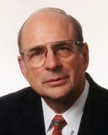
Norman R. Augustine

The Keynote address on Friday, June 2nd at the annual meeting of the U.S. National Commission for UNESCO is titled:

UNESCO and Rising Above A Gathering Storm
It is to be delivered by Norman R. Augustine, who is listed in the program as “Retired Chairman and Chief Executive Officer, Lockheed Martin Corporation”.

There is some background suggesting that this will be an especially interesting talk.

Rising Above A Gathering Storm is the title of an important and influential book published last year by the National Academies of Science. It was written by the Academies’ Committee on Prospering in the Global Economy of the 21st Century.
The group consisted of several corporate CEOs, university presidents, three Nobel Prize winners, several past presidential appointees, and distinguished teachers.
The chairman of the committee was Norman Augustine.

Not only that, but Augustine has a knack for turning a memorable phrase! (Click here for some examples.)

This report has been credited as significantly influencing the American Competitiveness Initiative announced by President Bush in the last State of the Union message. The Initiative, recognizing that America's economic strength and global leadership depend on continued technological advances, promises:
· a major increase in federal funding of fundamental research and development,
· incentives for private sector investments in research and development,
· a major effort to improve math, science, and technological education in our K-12 schools, and
· a new program of Career Advancement Accounts that workers and people looking for work can use to obtain training and other employment services.

Thus, the talk should be an exceptional opportunity to hear about the current and future state of U.S. competitiveness, and the role that UNESCO can play in helping assure that science and technology remain a vibrant force for American economic progress.