Saturday, August 26, 2006

UNESCO's follow-up to WSIS

The World Summit on the Information Society (WSIS) was one of the most important U.N. events in the last decade. It was organized by UNESCO and the International Telecommunications Union, and represented an important acknowledgement by the international community of the critical changes that are taking place with the Information Revolution. It set an international agenda of actions to help assure that progress toward the global information society is rapid and equitable.

UNESCO works with all stakeholders towards the implementation of the outcomes of WSIS, which involved major conferences in Geneva in 2003 and and Tunis in 2005, as well as many preparatory activities. UNESCO's role in the implementation process is three-fold:
* UNESCO implements concrete activities included in the Geneva Plan of Action within the framework of its regularprograme and budget.

* UNESCO helps facilitating the coherent implementation of the Action Lines in its areas of competence.

* UNESCO, together with ITU and UNDP, is engaged in shaping the overall multi-stakeholder coordination of the Facilitators of all Action Lines.
The next in a series of meetings at UNESCO's office in Paris relating to WSIS will be in October:
* 16 October 2006, "Access to information and knowledge"

* 17 October 2006, "Ethical dimension of the Information Society"

* 18 October 2006, "E-learning"

* 19 October 2006, "Media"

There will is also to be a meeting on 22 October 2006, at the Huarun Hotel, Beijing, China on "E-science"

All participants have to register online in order to obtain their badges to allow access to the meeting rooms.

Click here to go to the website devoted to UNESCO's activities implementing the plan of action developed at WSIS.
UNESCO's follow-up to WSIS

The World Summit on the Information Society (WSIS) was one of the most important U.N. events in the last decade. It was organized by UNESCO and the International Telecommunications Union, and represented an important acknowledgement by the international community of the critical changes that are taking place with the Information Revolution. It set an international agenda of actions to help assure that progress toward the global information society is rapid and equitable.

UNESCO works with all stakeholders towards the implementation of the outcomes of WSIS, which involved major conferences in Geneva in 2003 and and Tunis in 2005, as well as many preparatory activities. UNESCO's role in the implementation process is three-fold:
* UNESCO implements concrete activities included in the Geneva Plan of Action within the framework of its regularprograme and budget.

* UNESCO helps facilitating the coherent implementation of the Action Lines in its areas of competence.

* UNESCO, together with ITU and UNDP, is engaged in shaping the overall multi-stakeholder coordination of the Facilitators of all Action Lines.
The next in a series of meetings at UNESCO's office in Paris relating to WSIS will be in October:
* 16 October 2006, "Access to information and knowledge"

* 17 October 2006, "Ethical dimension of the Information Society"

* 18 October 2006, "E-learning"

* 19 October 2006, "Media"

There will is also to be a meeting on 22 October 2006, at the Huarun Hotel, Beijing, China on "E-science"

All participants have to register online in order to obtain their badges to allow access to the meeting rooms.

Click here to go to the website devoted to UNESCO's activities implementing the plan of action developed at WSIS.

Tuesday, August 22, 2006

UNESCO and the College Art Association: A Natural Partnership

Dick Arndt and Andre Varchaver published this article a couple of years ago, encouraging the participation of CAA members in Americans for UNESCO. It remains equally valid today.
AU’s goal, in collaboration with the U.S. National Commission, is to make U.S. participation broad-based, vital, and better understood.........AU board member Frank Method recently put it this way: “The U.S. today has its second chance to become a part of UNESCO; it if fails, there will be no third.”

UNESCO and the College Art Association: A Natural Partnership

Dick Arndt and Andre Varchaver published this article a couple of years ago, encouraging the participation of CAA members in Americans for UNESCO. It remains equally valid today.
AU’s goal, in collaboration with the U.S. National Commission, is to make U.S. participation broad-based, vital, and better understood.........AU board member Frank Method recently put it this way: “The U.S. today has its second chance to become a part of UNESCO; it if fails, there will be no third.”

DISCOVERING THE WORLD

UNESCO has published the Discovering the World series as a collection of compact guides aimed at making subjects accessible for a young readership (from 10 years old onwards). They are perfect for students of school or college age who need to prepare a text or presentation on any one of these subjects. Parents and teachers will also find these little books an interesting read. Many are in English, and some are in foreign languages (and they might be especially useful for those studying those languages, since they should have relatively simple vocabulary and sentence structure),

Here are some of the titles:

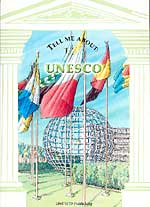
"Tell me about UNESCO"
All about UNESCO for the young (10-12 years old): its history, functioning, ideals, programmes and buildings. A clear and well-documented overview of the Organization working towards a better understanding of tolerance.

"Tell me about World Heritage"
This compact guide promotes the understanding of what it means to be included on the World Heritage List. Written in an accessible way and illustrated with many examples, the book touches on the meaning of heritage, the World Heritage Convention, the criteria for choosing sites and their protection. In short, information and projects that bring alive the meaning of heritage for a young audience.

"Cultures and Civilizations"
The history of humankind, its cultures and civilizations, is inextricably linked with the development of trade. Cities grew up around the markets and empires were built on the wealth that trade created. Across Asia, the paths of the Silk and Spice Routes brought together many different peoples, fostering the exchange of ideas, lifestyles, arts and goods. This book explores exciting aspects of intercultural relations brought about by the thriving trade along the Silk and Spice Routes.

"Inventions and Trade"
Over the centuries, the exchange of technologies -from the horse's bit and the wheel to the microchip and the computer- hasinspired new developments and improvements. It is through trade that much of this exchange has taken place. This book explains how the Silk and Spice Routes across Asia played an important role in bringing together different peoples and ideas that favoured new technologies and inventions in many fields: health and medicine, alchemy and chemistry, astronomy, mathematics, spinning and weaving. glass and ceramics, metalwork and agriculture, to mention just a few.

"Exploration by Land"
A fascinating account of the life and adventures, the discoveries and explorations of travellers along the Silk Routes, stretching over 8,000 kilometres through the heart of Asia, from the Mediterranean to the China Sea. They crossed some of the most spectacular and dangerous places on Earth: the Pamir Mountains, the Hindu Kush and the notorius Taklamakan desert whose shifting sands have been known to swallow up great cities.

"Exploration by Sea"
An exciting description of the adventures and discoveries of travellers along the Spice Routes, which stretched for over 15,000 kilometres around Asia, from China's seas, across the Indian Ocean up the Red Sea and the Persian Gulf and overland to the Mediterranean. A dangerous route, full of treacherous coral reefs, violent storms and unexpected pirate attack, which nevertheless tempted many sailors and adventurers seeking trade or treasure over the ages.

DISCOVERING THE WORLD

UNESCO has published the Discovering the World series as a collection of compact guides aimed at making subjects accessible for a young readership (from 10 years old onwards). They are perfect for students of school or college age who need to prepare a text or presentation on any one of these subjects. Parents and teachers will also find these little books an interesting read. Many are in English, and some are in foreign languages (and they might be especially useful for those studying those languages, since they should have relatively simple vocabulary and sentence structure),

Here are some of the titles:

"Tell me about UNESCO"
All about UNESCO for the young (10-12 years old): its history, functioning, ideals, programmes and buildings. A clear and well-documented overview of the Organization working towards a better understanding of tolerance.

"Tell me about World Heritage"
This compact guide promotes the understanding of what it means to be included on the World Heritage List. Written in an accessible way and illustrated with many examples, the book touches on the meaning of heritage, the World Heritage Convention, the criteria for choosing sites and their protection. In short, information and projects that bring alive the meaning of heritage for a young audience.

"Cultures and Civilizations"
The history of humankind, its cultures and civilizations, is inextricably linked with the development of trade. Cities grew up around the markets and empires were built on the wealth that trade created. Across Asia, the paths of the Silk and Spice Routes brought together many different peoples, fostering the exchange of ideas, lifestyles, arts and goods. This book explores exciting aspects of intercultural relations brought about by the thriving trade along the Silk and Spice Routes.

"Inventions and Trade"
Over the centuries, the exchange of technologies -from the horse's bit and the wheel to the microchip and the computer- hasinspired new developments and improvements. It is through trade that much of this exchange has taken place. This book explains how the Silk and Spice Routes across Asia played an important role in bringing together different peoples and ideas that favoured new technologies and inventions in many fields: health and medicine, alchemy and chemistry, astronomy, mathematics, spinning and weaving. glass and ceramics, metalwork and agriculture, to mention just a few.

"Exploration by Land"
A fascinating account of the life and adventures, the discoveries and explorations of travellers along the Silk Routes, stretching over 8,000 kilometres through the heart of Asia, from the Mediterranean to the China Sea. They crossed some of the most spectacular and dangerous places on Earth: the Pamir Mountains, the Hindu Kush and the notorius Taklamakan desert whose shifting sands have been known to swallow up great cities.

"Exploration by Sea"
An exciting description of the adventures and discoveries of travellers along the Spice Routes, which stretched for over 15,000 kilometres around Asia, from China's seas, across the Indian Ocean up the Red Sea and the Persian Gulf and overland to the Mediterranean. A dangerous route, full of treacherous coral reefs, violent storms and unexpected pirate attack, which nevertheless tempted many sailors and adventurers seeking trade or treasure over the ages.

The History of the Civilizations of Central Asia


UNESCO plays a valuable role in promoting and publishing serious historical studies. Click here to see a list of available historical publications from UNESCO Publishing. Especially noteworthy is the series on Civilizations of Central Asia, since this is an area of considerable current and historical interest, about which relatively little has been written.

Readers will discover through this six-volume work cultures that flourished and vanished from the dawn of civilization to the present time and how the history of the ancient and medieval world was shaped by the movements of peoples in this heartland of Eurasia, stretching from the Caspian Sea to the borders of China.
* Volume V: Development in Contrast: from the Sixteenth to the Mid-nineteenth Century
* Volume VI: Towards the Contemporary Period: From the Mid-nineteenth to the End of the Twentieth Century
* # Part One: The Historical, Social and Economic Setting
* Part Two: The Achievements
* Volume III: The Crossroads of Civilization: A.D. 250 to 750
* Volume II: The Development of Sedentary and Nomadic Civilizations: 700 B.C. to A.D. 250
* Volume I: The Dawn of Civilization: Earliest Times to 700 B.C.