Friday, September 15, 2006

Commemorating the 50th Anniversary of the 1st International Congress of Black Writers and Artists

The 2006 commemorative event is jointly initiated, planned and sponsored by Wole Soyinka, a Goodwill Ambassador to UNESCO , Laureate of the Nobel Prize in Literature and President of the African Community of Culture, and Henry Louis Gates, Jr, director of the W.E.B. Du Bois Institute for African and African American Research at Harvard University. The celebrations will take place September 19th-22nd at the Sorbonne University and UNESCO headquarters in Paris, France.

The symposium will feature personalities including Richard Wright, Aime Cesaire, and professors of African and African American Studies at prestigious US universities. They will discuss and compare approaches to the cultural and political expressions of contemporary Black writers and artists. The congress will address the question of the relevance of culture in the context of globalization and the development of racialized conflicts.

With its patronage, UNESCO is officially bringing its technical and financial support for this event mainly through the Division of Cultural Policies and Intercultural Dialogue and the Africa Department.

Event Schedule
Registration Form

Poster of the Congress© Succession Picasso 2006

Commemorating the 50th Anniversary of the 1st International Congress of Black Writers and Artists

The 2006 commemorative event is jointly initiated, planned and sponsored by Wole Soyinka, a Goodwill Ambassador to UNESCO , Laureate of the Nobel Prize in Literature and President of the African Community of Culture, and Henry Louis Gates, Jr, director of the W.E.B. Du Bois Institute for African and African American Research at Harvard University. The celebrations will take place September 19th-22nd at the Sorbonne University and UNESCO headquarters in Paris, France.

The symposium will feature personalities including Richard Wright, Aime Cesaire, and professors of African and African American Studies at prestigious US universities. They will discuss and compare approaches to the cultural and political expressions of contemporary Black writers and artists. The congress will address the question of the relevance of culture in the context of globalization and the development of racialized conflicts.

With its patronage, UNESCO is officially bringing its technical and financial support for this event mainly through the Division of Cultural Policies and Intercultural Dialogue and the Africa Department.

Event Schedule
Registration Form

Poster of the Congress© Succession Picasso 2006

Sunday, September 10, 2006

UNESCO will assist the Lebanon

Read the full release describing the assistance.

"UNESCO will assist the Lebanese government by providing support for vocational education, children and youth traumatized by recent events, and helping to preserve the country’s rich cultural heritage. These areas of immediate assistance, which will be part of the government’s early recovery efforts, were identified during a UNESCO mission to Lebanon last week led by the Director of the Organization’s Beirut Office, Abdel Moneim Osman. The mission met with Prime Minister Fouad Siniora, Culture Minister Tarek Mitri and Education Minister Khaled Kabbani.Damaged_school_Bint_Jbeil.jpg “UNESCO will spare no effort in extending its expertise to Lebanon,” said UNESCO Director-General Koïchiro Matsuura. “Sadly,” he added, “events over recent decades have provided the Organization with all too many occasions to work on post-conflict reconstruction. But this means Lebanon can draw on this experience – not only in the first early recovery phase, but also in later full-scale reconstruction.”

A Lebanese schoolhouse after the attack
Photo by UNESCO

UNESCO will assist the Lebanon

Read the full release describing the assistance.

"UNESCO will assist the Lebanese government by providing support for vocational education, children and youth traumatized by recent events, and helping to preserve the country’s rich cultural heritage. These areas of immediate assistance, which will be part of the government’s early recovery efforts, were identified during a UNESCO mission to Lebanon last week led by the Director of the Organization’s Beirut Office, Abdel Moneim Osman. The mission met with Prime Minister Fouad Siniora, Culture Minister Tarek Mitri and Education Minister Khaled Kabbani.Damaged_school_Bint_Jbeil.jpg “UNESCO will spare no effort in extending its expertise to Lebanon,” said UNESCO Director-General Koïchiro Matsuura. “Sadly,” he added, “events over recent decades have provided the Organization with all too many occasions to work on post-conflict reconstruction. But this means Lebanon can draw on this experience – not only in the first early recovery phase, but also in later full-scale reconstruction.”

A Lebanese schoolhouse after the attack
Photo by UNESCO

Friday, September 8, 2006

Happy Literacy Day!

As mentioned in our previous posting, September 8th is the International Literacy Day. This year’s theme is Literacy Sustains Development as "literacy is an indispensable means for effective social and economic participation, contributing to human development and poverty reduction".

In observance of the Literacy Day, a large number of Book Festivals and library events are held or scheduled for the coming days across the USA and the world. The US 2006 National Book Festival, for one, will be held on September 30. The event is organized and sponsored by the Library of Congress and hosted by Laura Bush. It is free and open to the public and features more than 70 award-winning authors, illustrators and poets appearing in "Fiction & Fantasy," "Mysteries & Thrillers," "History & Biography," "Children," "Teens & Children," "Poetry," and "Home & Family" pavilions. Browse this Web site to learn about the authors who will be appearing throughout the day in the pavilions and signing their books. >> More

UNESCO’s Literacy Initiative for Empowerment (LIFE) seeks to help reduce by half the rate of adult illiteracy in the world by 2015. As a global strategy to raise awareness on the importance of literacy, LIFE operations are country-led, respond to country-specific needs and priorities, and correspond to national capacities. Literacy projects in Cuba, Morocco, Pakistan, Rajastan (India) and Turkey are the winners of the five UNESCO 2006 Literacy prizes. A project in China was also awarded an Honourable Mention. >> More

Related
Book Fairs and other Literary Events throughout the USA

Happy Literacy Day!

As mentioned in our previous posting, September 8th is the International Literacy Day. This year’s theme is Literacy Sustains Development as "literacy is an indispensable means for effective social and economic participation, contributing to human development and poverty reduction".

In observance of the Literacy Day, a large number of Book Festivals and library events are held or scheduled for the coming days across the USA and the world. The US 2006 National Book Festival, for one, will be held on September 30. The event is organized and sponsored by the Library of Congress and hosted by Laura Bush. It is free and open to the public and features more than 70 award-winning authors, illustrators and poets appearing in "Fiction & Fantasy," "Mysteries & Thrillers," "History & Biography," "Children," "Teens & Children," "Poetry," and "Home & Family" pavilions. Browse this Web site to learn about the authors who will be appearing throughout the day in the pavilions and signing their books. >> More

UNESCO’s Literacy Initiative for Empowerment (LIFE) seeks to help reduce by half the rate of adult illiteracy in the world by 2015. As a global strategy to raise awareness on the importance of literacy, LIFE operations are country-led, respond to country-specific needs and priorities, and correspond to national capacities. Literacy projects in Cuba, Morocco, Pakistan, Rajastan (India) and Turkey are the winners of the five UNESCO 2006 Literacy prizes. A project in China was also awarded an Honourable Mention. >> More

Related
Book Fairs and other Literary Events throughout the USA

Thursday, September 7, 2006

The White House Conference on Global Literacy

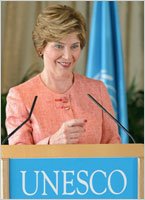
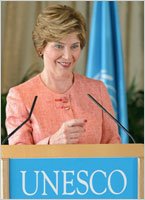
First lady Laura Bush,
honorary ambassador for the
United Nations Literacy Decade,
will host the Conference.
Photo: State Department(© AP Images)

The White House Conference on Global Literacy is to take place in New York City on September 18, 2006. Invitations to the literacy conference targeted first ladies, first spouses and ministers of education from countries with large populations or high illiteracy rates. According to U.S. officials, to date, roughly 25 first ladies and 40 ministers of education have responded that they will attend.

Officials from the White House and the U.S. State Department met yesterday with staff members from embassies around the world to discuss the upcoming White House Conference. At the informal briefing, Anita McBride, chief of staff to first lady Laura Bush, welcomed the officials and told them the first lady takes her role of honorary ambassador for the United Nations Literacy Decade “very, very seriously” and wants to make a contribution by hosting a major event to highlight successful literacy programs from around the world.

The conference will be delivered in seven languages and will include a luncheon at which attendees can share their reactions and ideas. It will include three panels that will present nine literacy programs from nine countries. The first panel will cover mother-child literacy and intergenerational learning and will be moderated by U.S. Department of Education Secretary Margaret Spellings. The second will discuss the positive effects literacy has on health and will be moderated by Randall Tobias, director of foreign assistance and administrator of the U.S. Agency for International Development. The third will discuss the role literacy plays in achieving economic self-sufficiency and will be moderated by Gerri Elliott, vice-president of Microsoft Corporation. Click here to download a PDF document containing a factsheet on the conference.

UNESCO reports that "the Conference will enlist the participation of the Director-General of UNESCO, Koïchiro Matsuura. UNESCO, as the lead agency for the Literacy Decade, will also provide technical assistance in identifying good literacy practices as well as the key characteristics of effective literacy programs." UNESCO is a consponsor of the Conference with various U.S. government agencies.

Mrs. Bush announced the Conference at an event in April that coincided with the annual celebration of UNESCO's Education for All (EFA) Week. Her remarks on that occassion are worthy of your attention, as the following excerpt demonstrates:
Training more teachers is vital to UNESCO's goal of making sure every child has access to a basic, quality education by 2015. This is important for every country, but especially for developing countries, where limited resources often mean that the neediest children are not educated. We have to make sure that all children -- boys and girls, rich and poor -- have access to a good education.

One of the best ways we can improve educational opportunities for all is by spreading literacy. And one of the most important reasons every child should have a teacher is so that every child can learn to read.

There's no such thing as a quality, basic education for a person who cannot read or write. Reading is the bedrock on which the entire mind is built -- one book, one essay, one instruction manual at a time. And reading doesn't just allow people to enjoy literary treasures. It allows them to become entrepreneurs, or engineers, or lawmakers, or doctors. In villages around the world, mothers who read can then teach their children how to read. Literate mothers can also participate in their economies, and they can earn a living for themselves and their families. So widespread literacy isn't a luxury for healthy societies -- it's a basic requirement.

Across the globe, more than 800 million people are illiterate. Eighty-five percent of them live in just 34 countries, concentrated in regions affected by poverty. And more than two-thirds of the 771 million adults who cannot read a simple book, or write a basic sentence, are women.

I've visited many countries around the world, and I've seen how efforts to expand literacy are improving lives, especially for women and girls.

Literacy Day
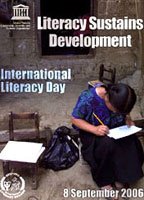
It is especially fitting that we are able to announce this meeting now, since tomorrow, September 8, has been designated by the United Nations as Literacy Day! The United Nations reports:
Literacy is a cause for celebration since there are now close to four billion literate people in the world. However, literacy for all – children, youth and adults - is still an unaccomplished goal and an ever moving target. A combination of ambitious goals, insufficient and parallel efforts, inadequate resources and strategies, and continued underestimation of the magnitude and complexity of the task accounts for this unmet goal. Lessons learnt over recent decades show that meeting the goal of universal literacy calls not only for more effective efforts but also for renewed political will and for doing things differently at all levels - locally, nationally and internationally.

The Literacy Day website has a large number of useful Internet links for those interested in the promotion of literacy. UNESCO also has created a website relating the organization's Literacy Day activities.