Tuesday, October 31, 2006

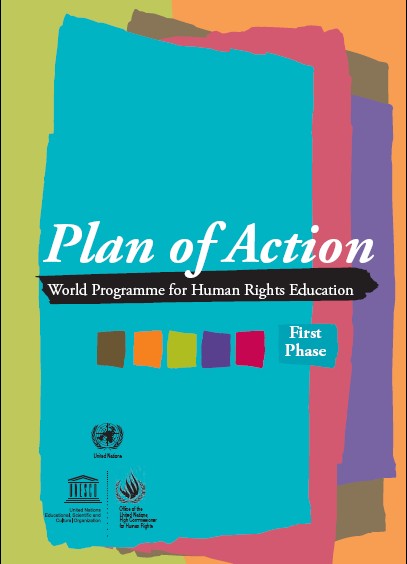
World Program of Human Rights Education - Plan of Action -

"The World Program for Human Rights Education (from 2005 onwards) aims at encouraging the development of sustainable national strategies and programs in human rights education.

This international trend highlights a consensus that the education system plays a vital role in fostering respect, participation, equality and non-discrimination in our societies.

It is important to bear in mind, however, that international programs can only support – and not substitute for – committed, vigorous and concerted national action. United Nations programs acquire real value only if national and local actors take responsibility for implementing them in their communities, and use them as mobilization and advocacy tools.

The Plan of Action for the first phase (2005-2007) of the World Program was adopted by all United Nations Member States in July 2005. It proposes a concrete strategy and practical guidance for implementing human rights education in primary and secondary schools." - Louise Arbour, Koїchiro Matsuura

World Program of Human Rights Education - Plan of Action -

"The World Program for Human Rights Education (from 2005 onwards) aims at encouraging the development of sustainable national strategies and programs in human rights education.

This international trend highlights a consensus that the education system plays a vital role in fostering respect, participation, equality and non-discrimination in our societies.

It is important to bear in mind, however, that international programs can only support – and not substitute for – committed, vigorous and concerted national action. United Nations programs acquire real value only if national and local actors take responsibility for implementing them in their communities, and use them as mobilization and advocacy tools.

The Plan of Action for the first phase (2005-2007) of the World Program was adopted by all United Nations Member States in July 2005. It proposes a concrete strategy and practical guidance for implementing human rights education in primary and secondary schools." - Louise Arbour, Koїchiro Matsuura

The U.S. Announces Two New International Exchange Programs

©Permament Delegation of the U.S. to UNESCO

At the Closing Plenary Session of the Fulbright New Century Scholar (NCS) Symposium at UNESCO in Paris, Assistant Secretary of State for Educational and Cultural Affairs, Dina Habib Powell announced the creation of two new U.S. initiatives: an International Fulbright Science and Technology Award, and an International Fusion Arts Exchange Program. Both programs will enable young people from different countries to come together for academic exchange at American universities.

The closing plenary session was hosted by the U.S. Department of State's Bureau of Educational and Cultural Affairs and the U.S. Permanent Mission to UNESCO. The Fulbright New Century Scholars program is sponsored by the Bureau of Educational and Cultural Affairs of the United States Department of State.

Dina Powell reminded her audience that:

“The U.S. recently worked within UNESCO and the OECD to develop guidelines for quality provision in cross border higher education, helping to share information and build capacity to promote international educational exchanges”,

before announcing:

“So we decided to create a new International Fulbright Science and Technology Award, which will bring outstanding international students to our country to study for Ph.D.'s in science and technology. "

She added:

“The arts create common understanding that transcends language and borders. Music is especially effective in this role and speaks very powerfully to young people. Since one of our primary goals is to reach young people internationally, what better way to do this, we thought, than through an exchange in music?

So I am absolutely delighted today to announce, here at UNESCO, the creation of a new international exchange, the Fusion Arts Exchange, that will allow young people from different countries to learn about, compose and perform popular music together. We will bring university students from countries with especially rich musical traditions-such India, South Africa, Mali, Brazil, and Ireland just to name a few-with American students, to study and work together at a U.S. university with a world-renowned music study program and facilities. They will look at international and U.S. musical traditions and composition, learn about careers and economic development opportunities for their societies in music-related fields, and have the chance to compose and perform together and develop on-going collaborations.”

Visit the Council for International Exchange of Scholars to find out more on Fulbright New Century Scholars Programs
The U.S. Announces Two New International Exchange Programs

©Permament Delegation of the U.S. to UNESCO

At the Closing Plenary Session of the Fulbright New Century Scholar (NCS) Symposium at UNESCO in Paris, Assistant Secretary of State for Educational and Cultural Affairs, Dina Habib Powell announced the creation of two new U.S. initiatives: an International Fulbright Science and Technology Award, and an International Fusion Arts Exchange Program. Both programs will enable young people from different countries to come together for academic exchange at American universities.

The closing plenary session was hosted by the U.S. Department of State's Bureau of Educational and Cultural Affairs and the U.S. Permanent Mission to UNESCO. The Fulbright New Century Scholars program is sponsored by the Bureau of Educational and Cultural Affairs of the United States Department of State.

Dina Powell reminded her audience that:

“The U.S. recently worked within UNESCO and the OECD to develop guidelines for quality provision in cross border higher education, helping to share information and build capacity to promote international educational exchanges”,

before announcing:

“So we decided to create a new International Fulbright Science and Technology Award, which will bring outstanding international students to our country to study for Ph.D.'s in science and technology. "

She added:

“The arts create common understanding that transcends language and borders. Music is especially effective in this role and speaks very powerfully to young people. Since one of our primary goals is to reach young people internationally, what better way to do this, we thought, than through an exchange in music?

So I am absolutely delighted today to announce, here at UNESCO, the creation of a new international exchange, the Fusion Arts Exchange, that will allow young people from different countries to learn about, compose and perform popular music together. We will bring university students from countries with especially rich musical traditions-such India, South Africa, Mali, Brazil, and Ireland just to name a few-with American students, to study and work together at a U.S. university with a world-renowned music study program and facilities. They will look at international and U.S. musical traditions and composition, learn about careers and economic development opportunities for their societies in music-related fields, and have the chance to compose and perform together and develop on-going collaborations.”

Visit the Council for International Exchange of Scholars to find out more on Fulbright New Century Scholars Programs

Report by the Director-General on the Implementation of the Program and Budget (32 C/5) and on Results Achieved in the Biennium 2004-2005


"This Report on the implementation of the program and budget during the 2004-2005 biennium represents an important milestone in the ongoing reform of the Organization. Firstly, it is the first biennial report after my re-election as Director-General, and I see it as setting a baseline for reporting during my second term. Secondly, the report provides answers to several issues concerning reporting raised by the Executive Board in the last few years."

Results Achieved for the Individual Main Lines of Action (MLA) of the Education Sector

Results Acheived for the Individual Main Lines of Action (MLA) of the Culture Sector

Report by the Director-General on the Implementation of the Program and Budget (32 C/5) and on Results Achieved in the Biennium 2004-2005


"This Report on the implementation of the program and budget during the 2004-2005 biennium represents an important milestone in the ongoing reform of the Organization. Firstly, it is the first biennial report after my re-election as Director-General, and I see it as setting a baseline for reporting during my second term. Secondly, the report provides answers to several issues concerning reporting raised by the Executive Board in the last few years."

Results Achieved for the Individual Main Lines of Action (MLA) of the Education Sector

Results Acheived for the Individual Main Lines of Action (MLA) of the Culture Sector

Monday, October 30, 2006

Learning through UNESCO Education Newsletters, Briefs and Journals

Check out the series of UNESCO thematic publication on education! The objective of these newsletters, briefs, journals, and bulletins is to provide a forum for disseminating newsworthy information on Education activities, experiences, best practices, etc… to facilitate the work of practitioners and education advocates. Reports marked by (*) are also available in selected languages.


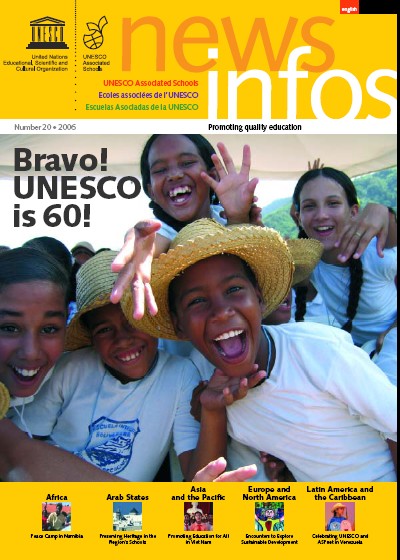
Associated School Project Network Newsletter


Adolescence Education Newsletter

Highlights country (Thailand) and regional news on Adolescent Reproductive and Sexual Health (ARSH) resources.


International Review of Education

International journal on the comparative theory and practice of formal and non-formal education.


Information and Communication Technologies in Education Newsletter:
Infoshare

Bulletin providing the latest trends and developments on the application of information and communication technologies in UNESCO programs and projects in the Asia-Pacific region.


International Institute for Education Planning (IIEP) Newsletter
(* also in French, and Spanish )

Provides the latest information on educational planning and management.


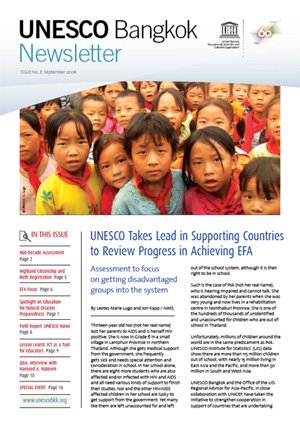
Education for All (EFA) Newsletter

Disseminates information on Education for All (EFA) activities, experiences and events as well as e-mail alert about new developments related to Education for All, new resources in the website and new additions to the growing list of network of experts and practitioners.


A scholarly publication dealing with major problems and trends in contemporary higher education.


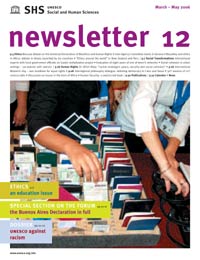
SHS issue on Ethics and Education (* also in French)

Provides information on the work of UNESCO in the field of social and human sciences. It is available both in printed and electronic form.


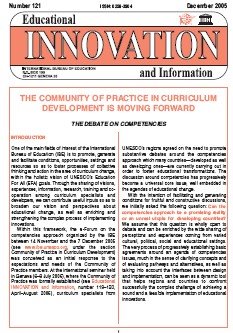
Provides short articles on current educational research and activities being conducted at the IBE and news from the field of comparative education.


Listening to Africa (*also in French)


International Bureau of Education's Newsletter:
Prospects
(* also in French and Spanish)


Informative newsletter of the UNESCO Office for Education in Latin America and the Caribbean.


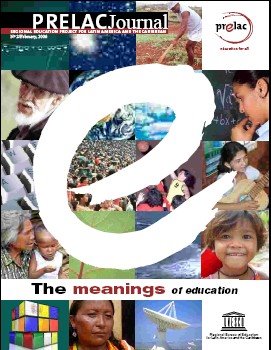
PRELAC Journal
(*also in Spanish)

A journal detailing the challenges of PRELAC (El Proyecto Regional de Educacion para América Latina y el Caribe/Regional Education Project of Latin America and the Caribbean) and its contributions to the objectives of the global movement of Education for All (EFA).


Want to know more?
*Newsletter on EDUCAIDS
*Policy Briefs on Early Childhood
*UNESCO Institute for Education - Nexus (*also in German)
*The UNESCO Courier (*also in French, Arabic, Spanish, Chinese, and Russian)
*Education Today (* also in French) - Newsletter on trends and innovations in education, on worldwide efforts towards Education for All and on UNESCO's own education activities.
*Connect - UNESCO International Science, Technology and Environmental Education Newsletter.
*Asia-Pacific Program of Education for All (APPEAL) - Reports on progress of on-going projects and activities of APPEAL.