DIRECTOR, DIVISION OF CULTURAL OBJECTS AND INTANGIBLE HERITAGE
Position Level: D1
Duty Location: Paris
Applications due by: 14 May 2009
Monday, March 23, 2009
Safeguarding the Underwater Cultural Heritage
 III. century wreck, Italy
© UNESCO/E. Trainito
The UNESCO Convention on the Protection of the Underwater Cultural Heritage, adopted in 2001, entered into force on 2 January 2009 after being ratified by 20 nations. It enables States Parties to better protect their submerged archaeological heritage from being damaged, looted or scattered away. It provides guidance for underwater archaeology. The first Meeting of States Parties to the Convention takes place on 26 and 27 March 2009. The exhibition "Cultural Secrets under the Waves" is expected to highlight the event.
- Information Brochure
- Frequently Asked Questions (in html or pdf)
- Online Film on the Convention
The Convention allows removal of underwater materials that are in danger. It is hoped that the staff from the Culture Program of UNESCO is coordinating with the staff of the Intergovernmental Oceanographic Commission to obtain expert advice on pollution, tsunamis and other oceanographic factors that might endanger specific underwater sites.
For North America, one of the most interesting archaeological issues is how the Americas were first populated. During the last ice age, there was a land bridge from Siberia to Alaska, and it is believed that tribal groups crossed on that bridge and their descendants eventually populated North and South America. The question is whether these people first moved down the coasts or whether they took advantage of the retreat of glaciers to move south through the middle of what is now Canada. Sea level has risen 100 feet since the peak of the ice age so that if these first settlers moved down the coasts, the fragile remains of their passing are likely to be underwater if they exist at all. With the rapid degradation of coastal zones, it would seem urgent to do the underwater archaeological work to find any such remains as would exist. A collaborative North American effort, perhaps facilitated by UNESCO might help. JAD
More on the Election of the Director General

Source: "Sexo e intriga en UNESCO (I)," Jorge Asís, Internacionales, March 8, 2009.
A new UNESCO Director General is to be elected in October, and Jorge Asis has provided an analysis of the state of the election in a Spanish language OP/Ed piece. He notes that in the spirit of geographical rotation of the post, given that the last three DGs were African, European and Asian, it is likely to be the turn of the Islamic peoples. Farouk Hosny, an artist an long time Minister of Culture of Egypt, is a leading contender. Morocco and Oman have apparently chosen to withdraw their nominees.
Asis suggests that two candidates from former Communist countries, Bulgaria and Lithuania, are in consideration but are less likely to be elected. He also notes the possibility of Marcio Barbosa, a Brazilian who is currently Deputy DG, but predicts that Barbosa may not obtain the full support of the Brazilian government that would be needed for his election.
Hosny is controversial in part for past anti-Israeli statements, especially unfortunate in the context of UNESCO's emphasis of dialog among cultures. Asis also suggests that while Hosny has strong support for the wife of Egyptian President Moubarak, his personal style may detract from the support he obtains from other Islamic nations.
Sunday, March 22, 2009
National Commission Meeting Postponed
The U.S. National Commission for UNESCO was scheduled to meet in May, but I have been told that that meeting will be postponed. The new U.S. Permanent Representative to UNESCO and the new Executive Director of the National Commission have not yet been appointed and there remain other vacancies on the State Department staff dealing with UNESCO. The meeting might take place in September when the new staff are in place to meet with the National Commission.
Saturday, March 21, 2009
World Poetry Day 2009
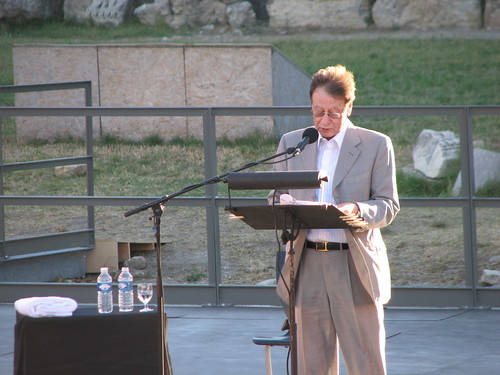 July 14, 2008 - Mahmoud Darwich
gave a poetry reading
in the ancient Roman Theater
to celebrate Actes Sud's 30th anniversary.
Photo: Khala via flickr
World Poetry Day is today, March 21st.
Among the various events organized at UNESCO Headquarters on this occasion is an evening, organized devoted to Palestinian poet Mahmoud Darwich, 2007 laureate of the Struga Poetry Evenings international festival.
I found on the Internet the following poem in translation attributed to Mahmoud Darwich:
My Mother
I long for my mother's bread
My mother's coffee
Her touch
Childhood memories grow up in me
Day after day
I must be worth my life
At the hour of my death
Worth the tears of my mother.
And if I come back one day
Take me as a veil to your eyelashes
Cover my bones with the grass
Blessed by your footsteps
Bind us together
With a lock of your hair
With a thread that trails from the back of your dress
I might become immortal
Become a God
If I touch the depths of your heart.
If I come back
Use me as wood to feed your fire
As the clothesline on the roof of your house
Without your blessing
I am too weak to stand.
Give me back the star maps of childhood
So that I
Along with the swallows
Can chart the path
Back to your waiting nest.
Tuesday, March 17, 2009
The United States and UNESCO
 View of the Capitol and its
reflection in Washington DC at night
©Olga Bogatyrenko
In 2007 voluntary contributions from the United States to UNESCO amounted to USD 3.3 millionUNESCO provides a website describing U.S. cooperation with the Organization.
Voluntary contributions have increased since the United States re-joined UNESCO in 2003. During its 19-year absence, the United States nevertheless continued to make voluntary contributions to a number of UNESCO’s activities.
Anthony O'Daly
On St. Patrick's Day I thought I would share this piece with you. The music is from Reincarnations by Samuel Barber sung by the Taipei Chamber Singers. It is a setting of the following poem:
Anthony O'DalyStephens, in turn wrote the poem as a "reincarnation" of the lament in Irish by my several times great grandfather, Anthony (Blind) Raftery (Antoine Ó Raifteiri also Antoine Ó Reachtabhra, 1784-1835). The original was written for Anthony O'Daly, a young Irishman hanged by the British as a rebel in 1820. Raftery is supposed to have witnessed the hanging.
Anthony!
Since your limbs were laid out
the stars do not shine!
The fish leap not out
in the waves!
On our meadows the dew
does not fall in the morn,
for O Daly is dead!
Not a flow'r can be born!
Not a word can be said!
Not a tree have a leaf!
On our meadows the dew
does not fall in the morn,
for O Daly is dead!
Anthony!
After you
there is nothing to do!
There is nothing but grief!
by James Stephens (1882-1950)
from Reincarnations, published 1918

Raftery was never published in his lifetime but the poems were stored in memory and in the Gaelic Renaissance were collected and published. Douglas Hyde, later president of Ireland, published Abhráin Atá Leagtha Ar an Reachtúire, Or, Songs Ascribed to Raftery in 1903. The book which is in both Irish and English has been made available on the Internet by Google Books. The Irish version of the poem, Anthony O'Daly, is on page 128 for those who might be interested.
Irish is identified by UNESCO as a language in peril of being lost, with only 44,000 native speakers. If it were to be lost, its heritage of thousands of years of poetry and literature would be seriously diminished. I would not that the Asian chorus, singing Anthony O'Daly, posted originally by Kuang-Chien Chen from Taiwan, is of a setting by an American composer. The intangible heritage, originally in the Irish language, has global importance.
John Anthony Daly
Subscribe to:
Comments (Atom)