Sunday, April 12, 2009

Young People Can Volunteer at UNESCO

Interns at the UNESCO Asian Youth Forum
Source: Korean National Commission for UNESCO: Luce Program - Korea
via Wellesley College Internship website.


UNESCO offers unpaid internships of one to four months to graduate and postgraduate students. The internships are available in UNESCO's Paris headquarters and also in UNESCO's field offices.

Depending on qualifications, these internships relate either to UNESCO's strategic activities or to administrative or technical functions. The aim is to provide an opportunity for professional experience in an international organisation which relates to and supplements interns' studies. UNESCO does not remunerate or pay interns. Costs and arrangements for travel, visas, accommodation, health insurance, and living expenses are the responsibility of interns or their sponsoring institutions.


The UNESCO office in Bangkok has an especially active program that not only offers internships but also puts non-student volunteers to work.


It appears that UNESCO decentralized institutes such as The UNESCO Institute for Lifelong Learning in Hamburg and The UNESCO-UNEVOC International Center for Technical and Vocational Education and Training in Bonn will sometimes provide internships.

The World Heritage Center offers opportunities to volunteer at World Heritage sites around the world.


Gorillas and Chimps are among the world's most endangered species. The UNESCO/IUCN Great Apes Survival Project (GRASP) looks for volunteers to help in their protection.


For several years the Institute for International Education managed a UNESCO Fulbright Fellowship Program for U.S. citizens funded by the State Department, but it seems no longer to be available.

Saturday, April 11, 2009

The University of Oregon to Host UNESCO Network Conference


The University of Oregon's Center for Intercultural Dialogue will host the United Nations Educational, Scientific and Cultural Organization (UNESCO) Chairs from the Intercultural Dialogue Program in the first U.S.-based meeting of the group.

Chairs from UNESCO's university twinning and networking system (UNITWIN) will come together May 8 to 12 in Eugene, Oregon. Seventeen of the 19 Chairs in UNESCO's Intercultural Dialogue Program will attend the conference. The Chairs - from Austria, France, Georgia, Israel, Kazakhstan, Kyrgyzstan, Lebanon, Moldova, Russia, Romania, Tajikistan, the UK and Uzbekistan - will present on their research on Friday, May 8.

Friday, April 10, 2009

U.S. Ratifies UNESCO Convention to Protect Cultural Property in Time of War

The Hague Convention for the Protection of Cultural Property in the Event of Armed Conflict was negotiated in 1954. On March 13, 2009 the instrument of ratification was presented to UNESCO Director-General Koïchiro Matsuura. The U.S. signed the Convention soon after its creation, and on September 25, 2008, the Senate voted to give its advice and consent to ratification. It is only after the Senate gave it consent that the United States became a full party to the Convention. The United States thus joins 122 other nations as a party to this treaty.

United States diplomats Stephen Engelken (center) and T. Michael Peay (left), present the instrument of ratification to UNESCO Director-General Koïchiro Matsuura.
© UNESCO/Michel Ravassard

Links of Interest

UNESCO Flash Info: The United States of America deposits its instrument of ratification of the 1954 Hague Convention for the Protection of Cultural Property in the Event of Armed Conflict


Convention for the Protection of Cultural Property In the Event of Armed Conflict (The Hague Convention), 14 May 1954


U.S Department of State International Cultural Property Protection


Ambassador's Fund for Cultural Preservation

Class: U.S. Foreign Policy and UNESCO - A View from the Top

Esther Brimmer
Recently confirmed as Assistant Secretary of State
for International Organizations


Michael Southwick spoke to our graduate seminar last night, drawing from his experience as Deputy Assistant Secretary of State during the Clinton and Bush administrations, and especially on his experience as the United States rejoined UNESCO.

Michael Southwick (and Frank Method)

There was a confluence of circumstances that resulted in the U.S. reentry into UNESCO:
  • It was generally agreed that the problems that had been cited when the United States withdrew from UNESCO had been ameliorated or resolved.
  • President Clinton had made a public statement at the end of his administration that the United States should rejoin UNESCO when the United States had paid the billion dollars it owed to the United Nations agencies. Thus when the debt had been repaid, the support of the Democratic leadership could be counted upon.
  • The State Department had done a low-level internal review of the value of UNESCO membership in terms of U.S. foreign policy interests which concluded that membership in UNESCO offered a low-cost alternative to achieve U.S. objectives in international education, science and culture, that UNESCO would be more effective than bilateral agencies in some locations important to U.S. foreign policy, and that letting UNESCO work in other locations would relieve the need for the U.S. government to take action.
  • Rep. Tom Lantos had introduced legislation in the House of Representatives calling for reentry which had passed.
  • The United Kingdom and Japan were strongly supporting U.S. reentry into UNESCO, and were combining personal appeals with more formal diplomatic contacts.
  • Key gatekeepers in the State Department and White House supported the reentry, as did the Secretary of Education and the First Lady.
  • Surprisingly, there had been no delegations from civil society leaders (in education, science or culture) to the State Department advocating reentry, and surprisingly there had been no request from Rep. Lantos for inputs from State on his UNESCO legislative initiative.
While the process was put on hold due to 9/11, it was found convenient to announce reentry when President Bush made a major address to the United Nations General Assembly. He received a standing ovation on making the announcement, something that is both exceptional and against UN rules on that announcement.

The reentry into UNESCO remained controversial within the Republican Party, but the opponents were unable to muster their forces when the decision was made; they were able to do so later, and key members of the Bush administration were only won over to support for UNESCO with years of experience with the organization.

Ambassador Southwick indicated that UNESCO one of 42 intergovernmental agencies for which the State Department Bureau of International Organization Affairs provides U.S. representation, and indeed receives less attention than others such as the United Nations itself.

He emphasized the importance of the Universal Declaration of Human Rights in the operations of the United Nations system, and characterized UNESCO (as seen from State) as the soul of the system, the agency in which intellectual leaders could debate important issues. UNESCO is a place in which American diplomats can hold serious discussions with diplomats from Islamic nations.

Within the State Department, the most prestigious posts deal with major countries -- Russia, China, etc. Foreign Service Officers, chosen for their economic and political expertise, depend on officers from other government agencies for substantive leadership as they deal with the specialized agencies in areas such as education, public health and agriculture. (He described leading a 90 person delegation to a meeting of the International Postal Union, in which 85 delegates came from the Postal Service including the Post Master General. U.S. Government policy is that even in such technical discussions, delegations be led by diplomats rather than sector specialists.) In these circumstances, there is little understanding of U.N. mission agencies in the higher levels of the State Department, and little attention to their programs.

In the discussion, Ambassador Southwick distinguished between the United Nations treaties, for which negotiations are led by diplomats, and programs of cooperation and assistance. He noted the fact that many key UN treaties have not been ratified by the United States, and the difficulties involved in trying to explain that failure to ratify a treaty does not imply opposition to its objectives.

One of his more interesting comments compared the process of negotiating an international agreement in a UN conference to the process of serving as a liaison of the State Department with the Congress. In both cases it pays to develop a strategy, recognizing the structure of the body in which the debate is taking place, and focusing on the key players in the negotiation.

There was some discussion of the means by which different governments influence international negotiations, ranging from diplomat-to-diplomat requests for support, to block voting, arm twisting of heads of government by heads of government, offers of increases in foreign aid, and even illicit financial incentives.

This was an exceptional opportunity for graduate students to get the straight information from someone who was really in the know, having lived the diplomatic process for years under different administrations. As such, it was an opportunity that might be unique in the Washington DC university system.

Check out:
Students Calder, Auten, Khouri, Tew and Cline
(and Method) listening to the speaker

Thursday, April 9, 2009

New digital library to display world on a website

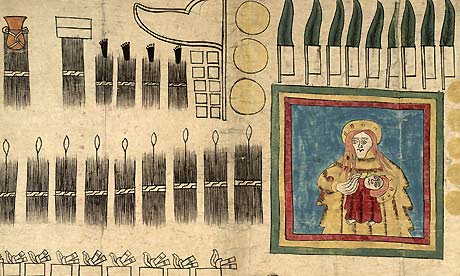
Huexotzinco Codex, 1531, documenting in pictographic language part of the testimony in a legal case against representatives of the colonial government in Mexico, ten years after the Spanish conquest in 1521. Photograph: Library of Congress

The Guardian has an article today on the forthcoming World Digital Library. I quote:
Four years after Washington's Librarian of Congress, Dr James Billington, suggested the idea, curators have accomplished the first stage in the construction of a truly global library. With all material free of charge on a website translated into seven different languages, the WDL is expected to be an unrivalled educational tool.

"We hope that this brings cultures together, that it promotes better understanding between those cultures and that it provides educational uses for a world in which reading and scholarship have to face competition from 24/7 media," said John Van Oudenaren, the director of the project.

Wednesday, April 8, 2009

UNESCO University Chairs and Networks in the United States

The UNITWIN/UNESCO Chairs Program, created in 1992, was conceived as a way to advance research, training and program development in higher education by building university networks and encouraging inter-university cooperation through transfer of knowledge across borders.

The 15 UNESCO Chairs in the United States are shown below, with the year in which they became part of the UNESCO network. Note that several of them were enrolled prior to the time when the United States rejoined UNESCO and the U.S. National Commission for UNESCO was revived, including three in Puerto Rico. (The number in parentheses represents the place in the list of Chairs in chronological order of enrollment.)
  1. UNESCO Chair of Education for Peace (1996), Universidad de Puerto Rico, San Juan de Puerto Rico (172)
  2. Mobile UNESCO Chair dedicated to the Problems of Habitability in the Hispanoamerican Cities and to the Integral Revitalization of their Historical Centres (1996), Universidad Interamericana de Puerto Rico, San Juan (173)
  3. Chaire UNESCO d'enseignement supérieur (1999), Universidad de Puerto Rico, San Juan de Puerto Rico (485)
  4. UNESCO Chair in Comparative Human Rights (2001), University of Connecticut, Connecticut (544)
  5. UNESCO Chair in Human Rights (2002), Florida Atlantic University, Boca Raton (595)
  6. UNESCO-Cousteau Ecotechnie Chair in Global Coastal Assessment (2004), University of Rhode Island, Narragansett (658)
  7. UNESCO-Cousteau Ecotechnie Chair in Coastal Resources (2004), The State University of New Jersey, Rutgers (665)
  8. UNESCO Chair in Communication (2000), The University of Texas, Austin (673)
  9. UNESCO chair in Inclusive Education (2005), The University of Colorado, Denver and Health Sciences Center (692)
  10. UNESCO Chair in Bioethics (2005), the Ethics and Public Policy Center, Washington D.C. (700)
  11. UNESCO Chair on Growing up in cities (2005), Cornell University, New York (702)
  12. UNESCO Chair in creating independent, pluralistic media: training and exchange program for journalists (2005), University of Colorado, School of Journalism and Mass Communication, Boulder (703)
  13. UNESCO Chair on Achieving the Promise of EFA: A Focus on Literacy and Sustainable Development (2006), Georgetown University, Washington, DC (741)
  14. UNESCO Chair in Transcultural Studies, Interreligious Dialogue, and Peace (2007), the University of Oregon (774)
  15. UNESCO Chair in Sustainable Rivers (2008), the University of Washington (808)
There are also two UNITWIN Networks headquartered in the United States:
  1. UNITWIN Network for Improving Biological Sciences Education through the Development and Use of Information Technologies in some Arab States Universities (318), established in 1997 at Purdue University, West Lafayette
  2. UNITWIN Network on Gender, Culture and People-Centered Development (780), established in 2007 at Boston University, Women’s Studies Program

Promote The Big Read to Help a Big Cause

In less than two weeks on April 20 through the 26, the Global Campaign for Education will have its Global Action Week highlighting one of the most neglected Education for All goals: literacy. Now is the time to plan big and small ways to support this extremely worthy endeavor!


UNESCO, as the chief coordinator of EFA and of the United Nations Literacy Decade (2003-2012) , fully supports this cause and will have events worldwide related to the Big Read. Director-General Koïchiro Matsuura, for example, will host an event at UNESCO headquarters on April 23 to commemorate the week. Listings of more events and other information can be found here.

As UNESCO and others strive to realize the EFA goal of cutting literacy in half, it is essential for all to promote literacy in every way possible. For more information on the campaign for literacy, see


and information on