Monday, October 4, 2010
Receive 3 free CEUs at Aspira Online Continuing Education
Visit Aspira's Offer page to see the details on the latest savings opportunity for MFT, LCSW and LPC CEUs. Only for the month of October. Refer a colleague and receive even more FREE CEUs!
Monday, September 20, 2010
What features make for a good online CE Provider?
Providing online CEUs is a BIG endeavor. What does it take to set a site apart from all the rest. This is a question that plagues all business people on the internet. This is why I am reaching out to all who wish to contribute. If you are a licensed professional who seeks their continuing education online, then I am interested in what you have to say. Post your comments to my blog. Let me know what would intrigue you from an online CEU provider. And, what would turn you off. It is not only good to know what people want, but to also know what they do not want. This combination of information can help to create an ideal environment for those who are seeking to renew their license via online CE courses. You can view Aspira's site at: www.aspirace.com. Thank you for your input. Have a great day!
Aspira Online CEUs for MFTs, LCSWs, and LPCs
Aspira Online CEUs for MFTs, LCSWs, and LPCs
Wednesday, June 3, 2009
Serpent Mound

Last week my wife and I visited Serpent Mound. The site has been added by the United States Government to the tentative lists of sites to be considered for
 UNESCO World Heritage status. The Great Serpent Mound is 1,330 feet in length along its coils and averages three feet in height. Excavation of Serpent Mound revealed wood charcoal that was radiocarbon dated to a time consistent with the Fort Ancient culture (AD 1000 to 1500). It is the largest documented surviving example of a prehistoric effigy mound in the world.
The coils of the snake appear to be chosen to point towards celestial sites, such as the the extreme points on the horizon for sunrise and sunset. The site chosen is a rock outcropping on the rim of an ancient meteor crater. Moreover, near the serpent mound on the site managed by the State of Ohio there are far mor ancient mounds.

After the visit I chatted with young people from nearby Indiana, discovering that they had never heard of Serpent Mound. Again, our schools seem not to do a very good job in acquainting their students with the pre-history of our region, even of globally significant artifacts that are near to them.
Hopewell Mound City
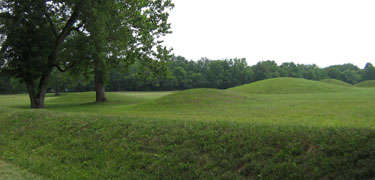 Last week I had the opportunity to visit Hopewell Mound City in southern Ohio. It is one of the nine archeological sites of monumental earthworks constructed by the Ohio Hopewell culture during the Woodland Period (1-1000 CE) which together have been added to the tentative list by the United States Government for consideration for World Heritage status.
The park protects the prehistoric remains of a dynamic social and ceremonial phenomenon that flourished in the woodlands of eastern North America between 200 B.C. and A.D. 500. The term Hopewell describes a broad network of economic, political, and spiritual beliefs and practices among different Native American groups. The culture is characterized by the construction of enclosures made of earthen walls, often built in geometric patterns and mounds of various shapes. The culture is known for a network of contacts with other groups, which stretched from the Atlantic coast to the Rocky Mountains. This network brought materials such as mica, shark's teeth, obsidian, copper, and shells to Ohio.The visitor center includes a video presentation and a small museum which helped to understand the artifacts collected from the site as well as the historical importance of the Hopewell people. We were especially grateful for the attention of three National Park Service staff members who work in the visitors's center and who spent considerable time explaining the site and its history.
I was especially taken by the fact that the site included objects made of copper that came from Canada, Obsidian from deposits near Yellowstone, mica from the Carolinas, and shells from the Gulf coast. While this was a culture that lived on hunting and gathering, the Hopewell peoples also understood astronomy, could build large earthwork structures, and obtained materials that they valued from all over the North American continent.
World Heritage status for the sites preserving the monuments of the Hopewell culture may help Americans to recognize the accomplishments of the people who lived on the continent before 1492. I wish that all the school children in the United States would learn about the pre-Columbian cultures of the continent!
 Images from the National Park Service.
Tuesday, June 2, 2009
More Candidates for Director General
 Nominations are now closed for the post of Director General of UNESCO.
Yojana Sharma has published an update of her earlier article, identifying two new candidates, each of whom would add some luster to the list of Directors General of the Organization:
- Benita Ferrero-Waldner, the European Union commissioner for foreign affairs and a former Austrian foreign minister
- Alexander Yakovenko, Russia's deputy foreign minister and former Ambassador to the United Nations.

Sunday, May 31, 2009
What is Expected of a UNESCO Chief
A reporter contacted me to ask what will be expected of the new Director General of UNESCO, to be elected in October. I will share my thinking with the readers of this blog:
Of course, the Director General is the Chief Executive Officer of the United Nations Educational, Scientific and Cultural Organization, responsible to its General Conference and Executive Board for the conduct of the programs of the Organization. He leads an organization with some 2000 staff members spread over some 58 nations, which has a budget in excess of US$500 million. The designers of the organization, recognizing the complexity of the governance pf UNESCO, created the post of Director General with a considerable amount of authority and independence.
I believe however that this traditionalist view of UNESCO and its Director General tells only a part of the story. UNESCO is especially important in its roles of convening people and organizations to work together. Thus it reaches out to the global education, science and cultural communities through a network of National Commissions in each of its member states. The U.S. National Commission, for example, has 100 members, most of whom in turn represent important educational, scientific or cultural organizations within the United States. UNESCO links educators worldwide in leading the Education for All program. Its intergovernmental scientific organizations link scientists worldwide in areas such as oceanography and geology. It has convened networks of nearly 900 world heritage sites, hundreds of bioreserves, thousands of UNESCO clubs, thousands of UNESCO associated schools, as well as a large network of university chairs. The Director General stimulates and encourages the work of these networks, of course often working through his staff and offices reporting to him.
UNESCO, created in the aftermath of World War II, states in its constitution that since wars are created in the minds of men, it is in the minds of men that we must begin to build the defenses of peace. UNESCO's mission is thus to build those defenses. One of my friends has called UNESCO the conscience of the United Nations system. The Director General has singular moral authority to encourage the development of a culture of peace and a dialog among nations. He regularly denounces violence against reporters and abuses of freedom of the press.
The first Director General was Julian Huxley, scion of the famous Huxley family and a world famous scientist in his own right. He was followed by Luther Evans, a historian who had been the Librarian of Congress, world's largest library and certainly its most influential library at the aftermath of World War II. These men, with their successors by their examples endowed the Director General of UNESCO with great moral authority, especially in matters of education, science, culture and communications.
Rather than try to say what is "expected of" the new Director General, I would say that was is hoped for from the man is:
Of course, the Director General is the Chief Executive Officer of the United Nations Educational, Scientific and Cultural Organization, responsible to its General Conference and Executive Board for the conduct of the programs of the Organization. He leads an organization with some 2000 staff members spread over some 58 nations, which has a budget in excess of US$500 million. The designers of the organization, recognizing the complexity of the governance pf UNESCO, created the post of Director General with a considerable amount of authority and independence.
I believe however that this traditionalist view of UNESCO and its Director General tells only a part of the story. UNESCO is especially important in its roles of convening people and organizations to work together. Thus it reaches out to the global education, science and cultural communities through a network of National Commissions in each of its member states. The U.S. National Commission, for example, has 100 members, most of whom in turn represent important educational, scientific or cultural organizations within the United States. UNESCO links educators worldwide in leading the Education for All program. Its intergovernmental scientific organizations link scientists worldwide in areas such as oceanography and geology. It has convened networks of nearly 900 world heritage sites, hundreds of bioreserves, thousands of UNESCO clubs, thousands of UNESCO associated schools, as well as a large network of university chairs. The Director General stimulates and encourages the work of these networks, of course often working through his staff and offices reporting to him.
UNESCO, created in the aftermath of World War II, states in its constitution that since wars are created in the minds of men, it is in the minds of men that we must begin to build the defenses of peace. UNESCO's mission is thus to build those defenses. One of my friends has called UNESCO the conscience of the United Nations system. The Director General has singular moral authority to encourage the development of a culture of peace and a dialog among nations. He regularly denounces violence against reporters and abuses of freedom of the press.
The first Director General was Julian Huxley, scion of the famous Huxley family and a world famous scientist in his own right. He was followed by Luther Evans, a historian who had been the Librarian of Congress, world's largest library and certainly its most influential library at the aftermath of World War II. These men, with their successors by their examples endowed the Director General of UNESCO with great moral authority, especially in matters of education, science, culture and communications.
Rather than try to say what is "expected of" the new Director General, I would say that was is hoped for from the man is:
- leadership in advancing the mission of UNESCO
- to be a strong and credible spokesperson for education, science, culture, communications, and peace
- to effectively promote intercultural understanding and respect for cultural diversity
- continued progress in improving the operation of the staff of the organization, as well as leadership in developing and allocating resources, and managing UNESCO's programs
- promoting and leadership in coordinating the global efforts of the networks inspired by and linking to UNESCO.
New Board Member Publication
I published a short piece on the online magazine, Foreign Policy Digest, titled "How Technology Can Support Education in Africa". It describes some UNESCO efforts as well as other examples of use of information and communications technology applicable to education in Africa.
Subscribe to:
Posts (Atom)